Showing posts with label Practicum-Patrick. Show all posts

Wednesday, May 4, 2011

Practicum #3 - Patrick

Browsing the various communications channels I found for Anonymous, especially for OpLibya, was enlightening to say the least. Here is a network that is far from what most people would ever interact with, a combination of activists and trolls joined together to fight for...well, who knows? Some are there because they want to save lives, while others are there fighting for "the rights of people everywhere", while others admit they're only there to poke a bear in its eye and for the resulting lulz (which can be essentially be defined as schadenfreude).

The conglomeration never tries to make sense of itself as a whole. The idea of philosophical unity seems to be hilarious no matter how much some activists wanted otherwise. Regardless, there were general agreements amongst those I talked with and from what I observed. First, security was paramount. Regardless of whether someone wanted to just talk, to help with getting communications through, or take down the Libyan government, self-protection came before anything else. You needed to expect your online activities to be tracked, observed, and even attacked, no matter your role. What I learned on security will be talked about in the next forum post.

The second agreement was that if you were there, you were doing something or you were worthless. You needed to use whatever expertise you had to teach people on the other side of the world (often through Google Translate or the like) or to attack the tools of the Libyan government, such as websites, networks, or propaganda.

I went into this hoping to be involved non-aggressively. That is, I didn't want to be involved in any denial of service actions, or to otherwise hack Libyan websites. A combination of worry about legal implications and of drawing attention back to myself made that decision for me. From reading about my options, I decided I would help by setting up a Tor Relay, a way for encrypted traffic to use the internet connections I had available to get through censorship software and avoid eavesdropping.

Practicum #4 - Patrick

Securing oneself when working with online activists and against governments is of paramount concern. In fact, in every place where I found ways to work with Anonymous, the first information given is how to hide what you do and protect yourself. I intended to set up Tor relays for my first assistance, but before I set up Tor on my machines, I set up other protections.

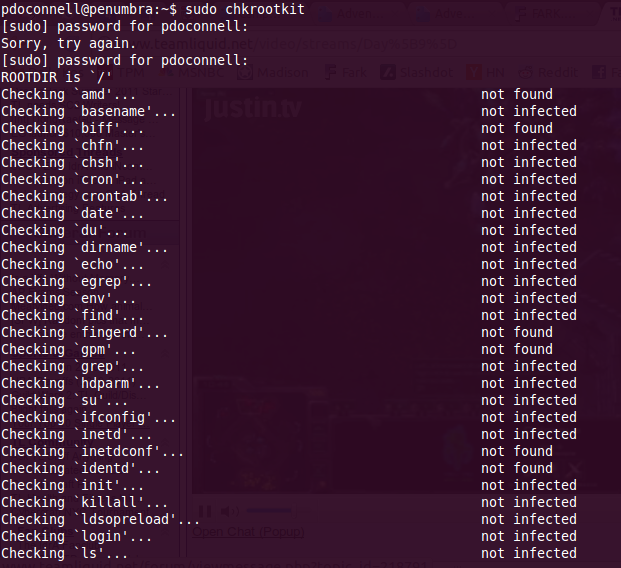
First, I logged into my router and prevented any traffic on certain ports to get into my computers. In this way, there was a basic level of protection that I could further tighten. Then on the server I run at home I set up far stronger protections. On it, I installed a strong firewall. This locked down my system heavily, so that only traffic I know about will be traveling to or from the server. Secondly, I installed antivirus and rootkit detectors. Even though I run a linux-based server, I have seen it compromised before and given that I could be dealing with governments or skilled hackers trying to prevent me from sending the aid I was intending to, I wanted to leave nothing insecure.

The last few things I did are more intricate than are required by this post, but included full-disk encryption, memory and swap-space encryption, user-right restrictions, and more. Most of these were suggested either in AnonOps IRC channels or forums, but some came from Tor's website. In my next post, I will describe what Tor is and why it was useful assistance to run it.

Monday, March 28, 2011

Practicum #2 - Patrick

I have been working long on this project partially because of how the community in question, Anonymous, helps illustrate the nebulousness of the term "Web 2.0". Anonymous is defined in part because of its collaborative nature, and how those who participate in some of its activities can ignore or actively dislike or work against others. When working together, it is often via tools that other members have access to, such as the LOIC (low-orbit ion cannon). It is a DDOS (distributed denial-of-service) software that volunteers run on their computer to help bring down websites and online services. Targets are determined via community suggestion, such as the website of the Tunisian internet service providers that were filtering protest material during the beginnings of their revolution in January or the websites of Visa and PayPal for prohibiting the use of their services in fundraising for the defense of Private Manning, the accused source of the majority of the Wikileaks information.

Outside of their communal attacks, Anonymous also works to inform those who want to participate how to protect themselves. They have a large collection of user-generated manuals for how to encrypt and hide their web activities given their sometimes questionable legal standing and risk for reprisal. My next post will be entirely on this matter.

Interestingly, although the group functions in what could be called a "Web 2.0" manner, the methods by which it spreads its information are definitely older than that. Anonymous was founded on 4chan.org's /b/ discussion board (note: EXTREMELY not safe for work, expect potentially disturbing content), where users typically have no usernames and where content evaporates quickly as newer content is created. From there, it moved to an older style forum at http://forums.whyweprotest.net/. Independent of their, it also operates via IRC (internet relay chat), a method first used in 1988 and common through the early days of the public internet. It also functions via Twitter, Facebook, Tor, and any other communication medium available online that can be thought of, although those are not methods used for their main group discussion and interaction.

For tomorrow's presentation, something I would like everyone to think about is whether Web 2.0 is defined more by the tools a community uses (wikis, Facebook, et cetera) or instead by the process by which it operates.

Sunday, March 27, 2011

Practicum #1 - Patrick

For my project, I have been working on the topic of specialized information communities. Specifically, I was interested in online activism and involvement regarding censorship and media freedom in the Middle East and North Africa. As a result, I began investigating how to become involved in what is known as OpTunisia, OpLibya, and OpIran, all projects of Anonymous.

I became interested in these projects as a result of communication with friends and acquaintances in the hacking community in that part of the world. I had met many of them during the Green Revolution in Iran. During that time, I began to hear about how remote activists could get involved from overseas. People could help inform activists within countries that were attacking them (metaphorically and often physically) on how to evade tracking, keep the flow of information in and out of the area going, and more. I wanted to be part of that, and I needed to find the communities and tools that would allow me to do so.